
Lessons learned on the way to Waterloo
Here’s something I didn’t expect to feel so strongly about at the end of our first big EV road trip: I absolutely love this car.
Not in a “new car smell” kind of way, although yes, it still smells incredible, but in the way you fall in love with something that makes your life tangibly better. Driving this EV is smooth, powerful, quiet, and intuitive. The seats are more comfortable than any vehicle I’ve ever owned. The back seats recline so Matty can nap like a king. The trunk swallows up hockey bags, volleyball bags, food coolers, swim gear, and half the contents of our garage. The tech is smart. The trip planner is genius. And it accelerates like a dream.
The day I picked up my new EV, I wasn’t expecting to be emotional.
But I was.
Because that very night, Matty and I went to the last regular season Ottawa Senators game at the Canadian Tire Center. It was electric, literally and figuratively. The arena was buzzing with fans, hope, and playoff dreams. And for me, it was the first time back since Shawn passed.
It was bittersweet and healing all at once. The energy, the music, the joy of the crowd — they reminded me how much I missed being in places filled with life. It felt good to be there. To be part of something joyful again.

Lesson #1: EV Range ≠ Gas Range
After the game, I noticed something off. It’s 43 km from my place to the Canadian Tire Center. But the car’s range had dropped by more than 50 km.
Say what?
That’s when I learned the hard truth: an EV’s range isn’t a 1:1 relationship with distance like a gas car. It’s more like a suggestion… influenced by speed, temperature, driving habits, and probably whether Mars is in alignment.
Thanks to my friend who’d just purchase the Ford Lightning, I got the heads-up to “watch how fast your range drops compared to the kilometers you actually drive.” Very helpful. Very true.
Lesson #2: Plug It In… Properly
Back home after the game, I plugged in the car using a regular 110V outlet. The light turned green. I did a little happy dance and walked away.
Fast forward 24 hours, we’re packing up to leave for Zach’s volleyball tournament in Waterloo. I check the car… still at 62%.
WHAT?!
Turns out green means “ready to charge.” Not charging. It’s blue you want. BLUE. How was I supposed to know this?! Green has always meant go!
So yeah, I basically let the car sit for 24 hours thinking it was juicing up when it was just chilling.
Lesson #3: Download All the Apps (No, Seriously, All of Them)
On the road, I realized I couldn’t use any of the charging networks until I had the right apps. Not just the Nissan app, but FLO, ChargePoint, Shell Recharge, and whoever else is in this club.
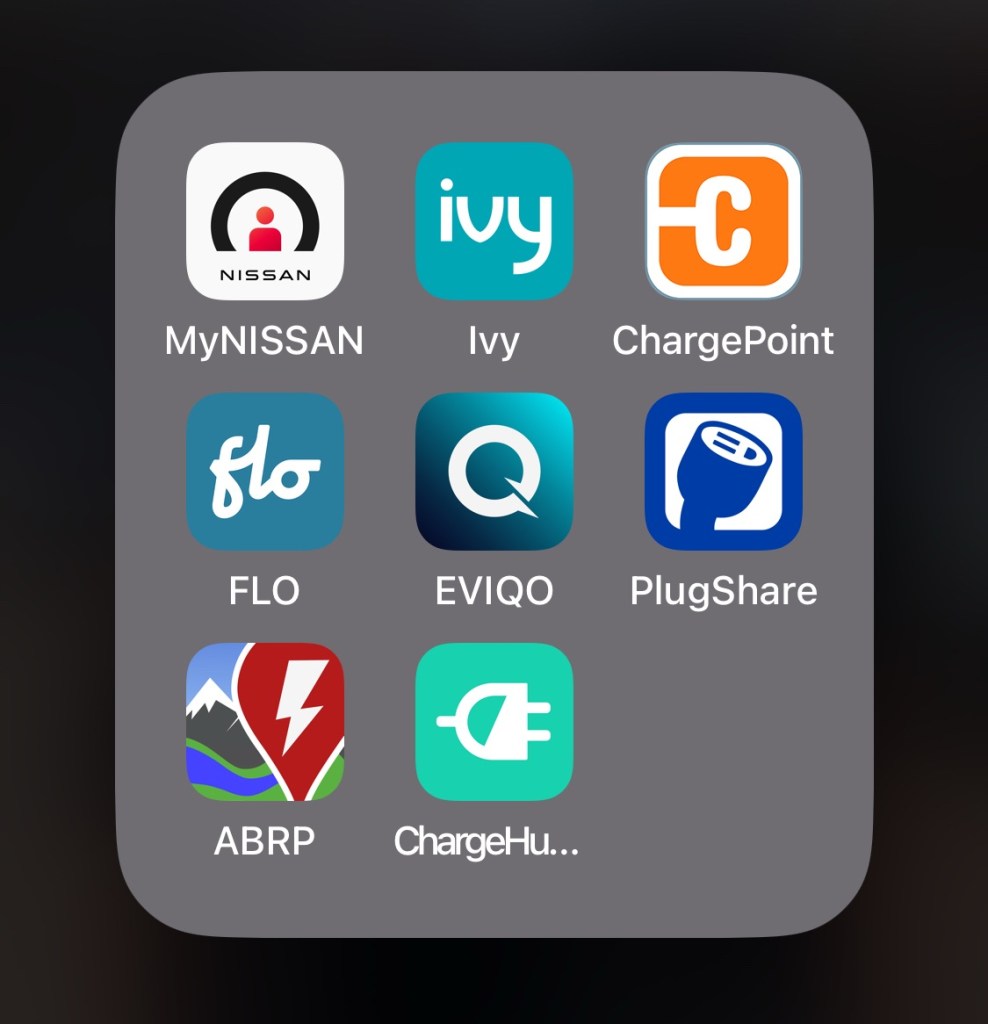
So there I was, somewhere on the 401, with Zach in the passenger seat, downloading apps like a maniac and setting up accounts while trying to find chargers that worked. Because…
Lesson #4: Not All Chargers Work (Even If The App Says They Do)
Our first stop at an ONroute: dead charger.
Everyone was hangry. Matty gave me a look but also reassuringly said, “It’s ok, we’re still figuring this out”… this kid!
We jumped back on the road and found the next ONroute, which thankfully had a working fast charger.
We plugged in, ate lunch, and by the time we were done, the car was almost fully charged. Win!
Lesson #5: The Nissan App is My New Best Friend
The Nissan app is… phenomenal. And yes, downloading this a should have been the first thing I did after purchase.
It tells me:
- How much charge I have
- How long it’ll take to reach a percentage
- If the car is actually charging
- Where the car is
It lets me:
- Honk the horn or flash the lights to find it
- Lock or unlock it remotely
- Set the temperature inside
And best of all: Trip Planner
Trip Planner is my holy grail. It maps out your route, tells you where to stop, how long to charge, and how far you’ll make it. It even sends the whole thing to your car’s GPS.
Once I learned to use that? Game officially changed.
Lesson #6: Cruise Control + Eco Mode = Your Best Friends
Back on the road, I drove like I normally would in my gas car, passing people, accelerating for fun, generally feeling sporty.
Big mistake.
The range started dropping like it was allergic to forward motion. Zach, already nervous about getting to his tournament on time, started to panic.
“Mom, are we going to have to stop again?! This is going to take eight hours!”
Meanwhile, Matthew was in the back, headphones in, audiobook on, living his best unbothered life.
Thanks to Kyle (my personal EV crisis hotline) and a little help from Google, we figured it out: Cruise between 100–110 km/h. Switch to Eco mode. Turn on e-Steps for regenerative braking.
Suddenly… magic. The range stabilized. We were in the EV zone.
Lesson #7: Grocery Stores with Chargers Are Gold
Just before reaching Waterloo, I needed to stock up on snacks for the tournament. Found a grocery store with a super-fast charger (bless you, PlugShare app). I plugged in, shopped, came back, and boom, 85% charge.
Multitasking at its finest.
Lesson #8: Call the Hotel First (and Ask About Chargers)
Before booking the Holiday Inn Express, where the team was staying, I called to ask if they had an EV charger. They did, and it was free for guests. That made it an easy decision.
By the time we arrived in Waterloo, I felt like I’d completed an accelerated EV boot camp. We made it!
Everyone needed a break. Tensions were high from the six-hour drive that should’ve taken four. The boys each took their corner of the room, and I did what I always do during tournaments: I headed downstairs to the lobby to meet up with a few of the parents for the usual night-before chatter, the kind that’s half strategy, half therapy, and all community.
Later that night, I went to plug in the car, and guess what?
Both hotel chargers were blocked by cars that were already fully charged.
One had been plugged in for over six hours. The screen literally said “100%.” The other, same story. Meanwhile, I was stuck with 35% and needed to charge overnight.
The hotel staff did their best to track down the owners. But this brings me to my next, and most passionate lesson:
Lesson #9: EV Etiquette Is a Thing. Please Learn It.
EV Etiquette Isn’t Optional. It’s Necessary
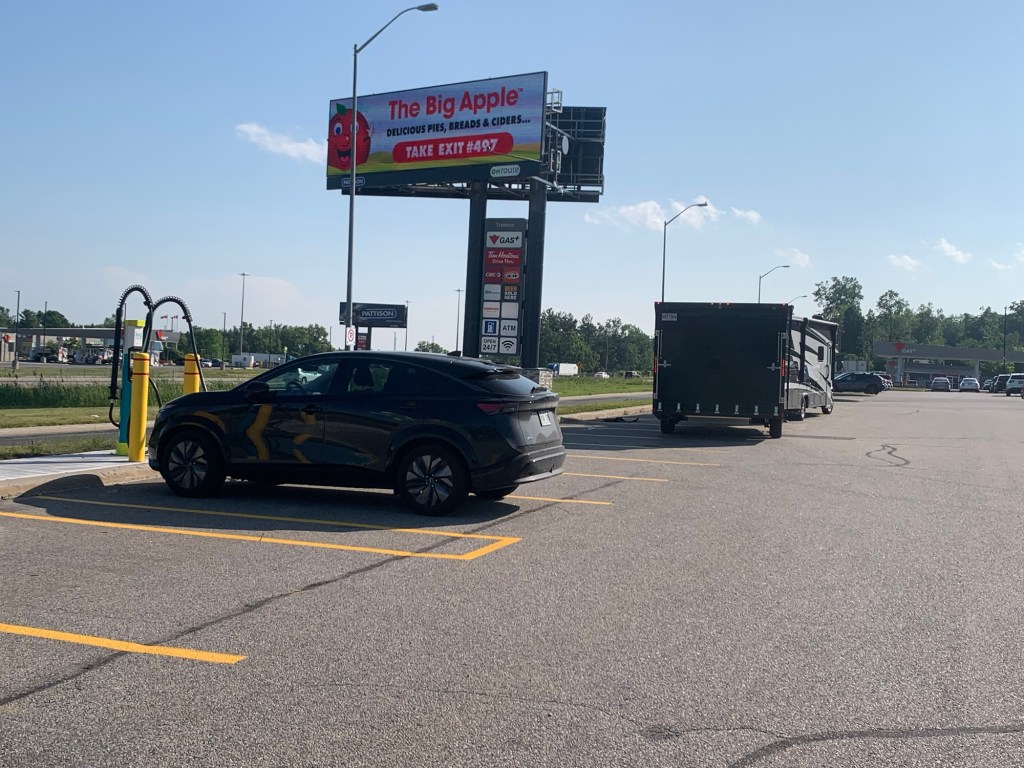
There were two EV chargers in the hotel parking lot. Both were occupied.
And both chargers told me the same thing: “Charging Complete – 100%.”
That’s the thing with EVs: if your car is plugged in and done charging, the screen tells the truth. It’s not like a gas car where someone might think, “Maybe they just went in for coffee.” No. These cars had been fully charged for hours and were still taking up space. No movement. No consideration.
I stood there staring at those screens, frustrated and helpless.
I went to the front desk. The staff were fantastic, they understood immediately. They tried calling the guests in those rooms, but there was no answer. I wasn’t the only one in line, either. By that point, two more EV drivers had pulled in, all of us looking around at each other like, “What are we supposed to do now?”
This is where EV etiquette matters. A lot.
This isn’t about being “nice.” This is about shared infrastructure. In hotel parking lots, in small-town plazas, and even on long-distance highway stops, charging spots are finite. We are all depending on each other to keep the system moving.
The golden rule is simple: when your car is done charging, move it.
Would you leave your car at the gas pump for two hours while you went shopping? No. So don’t do it at a charger. Leaving your car at an EV charging station after it’s full is the equivalent of leaving your car at a gas station and taking a nap.
And I’ll take it a step further, hotels and public chargers need to get proactive:
Hotels should include a one-pager at check-in for EV drivers, outlining etiquette, charger time limits, and what happens if your car is still parked after completion. Add signage that makes the expectations clear: “Please move your vehicle once charging is complete.” Incorporate alerts or overstay fees for extended occupancy on finished chargers, as some networks already do (Electrify America, FLO, etc.). Fellow drivers, leave a note on your dash if you’re running in briefly and can be contacted. A tiny act of courtesy goes a long way.
The truth is, EVs are growing faster than the infrastructure is. We need more chargers, yes, but until then, we have to take care of each other.
Being part of the EV community means recognizing that your decisions affect other people’s ability to get home, get to work, or, in my case, get to their kid’s volleyball tournament without panic and stress.
So please, if you own an EV:
- Check your app notifications
- Know when you’re done charging
- Be considerate
- Move your car
Because if we all pretend it’s “someone else’s problem,” no one gets to move forward.
Lesson #10: Zach’s Summer Oasis on Wheels (and a Word on Speed)
Zach, who just got his license not long ago, is obsessed with this car. He’s constantly finding reasons to take it out, off to pick up friends, run errands, or just cruise with the music up and the windows down. But here’s the best part: he’s turned the trunk into his own personal summer oasis.
Every time he leaves, it’s:
“Mom, I’m ready for anything.”
Golf clubs? Check.
Swim trunks and towel? Packed.
Pickleball paddles, volleyball, tennis rackets, basketball? All in there.
He’s a walking sports complex on four wheels. His friends call, and he’s already halfway out the door yelling, “Which court are we going to, guys?”
It’s pretty adorable, and incredibly practical. This car fits everything.
BUT, and here’s a big one…
A Very Important Lesson: EVs Can Fly
This car accelerates faster than you’d expect. Like, really fast. Zero to “oh wow, am I in a video game” fast in two seconds. It’s smooth and silent, but powerful.
So, if you have a teen or a new driver in your household, please have the responsible driving conversation early. This isn’t your typical starter car. It’s quiet, yes, but that doesn’t mean it’s slow.
For everyone’s safety, talk about speed, limits, and the very real responsibility that comes with a car that drives this beautifully.
Lesson #11: Install a Fast Charger at Home
I tried surviving on the slow 110V for a bit, but it caused more stress than it solved. So I invested in a Level 2 home charger.
Best. Decision. Ever.
Now I only need to plug in every few days, not every night. And thankfully, my work parking lot has free chargers with a 3-hour max limit. More of this, please!
Lesson #12: The Car Isn’t a Problem, the Infrastructure Is
By the end of the weekend, I had learned something really important that I hadn’t quite put into words until then.
This EV? It’s not just “good enough.” It’s better.
Better than any gas car I’ve ever had. Hands down.
The drive is smoother. The acceleration is unreal. The seats are more comfortable. The layout is smarter. The features, the climate control, the trip planner, the silence of the ride, the spaciousness of the trunk, it’s all next level. I’m not exaggerating when I say that this is the most enjoyable driving experience I’ve ever had.
But here’s the thing…
The car isn’t the challenge. The infrastructure is.
You’ll hear people talk about “range anxiety” or “EV stress” as if it’s the car’s fault. But the truth is, if we had a fully developed, standardized, and enforced public charging network, none of this would be a problem.
And that’s where reality still lags behind the promise.
Free Charging is Out There, But You Have to Know Where to Look
One of the best things I discovered over the last few weeks is that there are a surprising number of free chargers sprinkled throughout the city.
They’re not always obvious. They’re often tucked behind malls, libraries, community centers, and grocery stores. Some of them are sponsored by municipalities, some by retailers like IKEA (shout-out to IKEA for offering free but very slow charging), and others by workplaces trying to support green commuting.
In Waterloo alone, there are over 170 chargers within a 15 km radius, and many of them are free Level 2 chargers you can access while you shop, run errands, or wait during tournaments.
These chargers are lifesavers when you plan ahead, but you need the apps to find them (PlugShare, ChargeHub, even Google Maps now tags them).
Dealerships: The Hidden Charging Network (But Not Free)
And then there are the dealership chargers, which I didn’t know much about until this trip. Nearly every Nissan dealership has Level 2 or DC fast chargers on site. They’re typically in use for their own customers or service vehicles, but many are open to public charging as well, for a fee.
They don’t advertise it loudly. You often have to go in and ask, or check the PlugShare app to see if they’re listed. But they’re there, and in a pinch, they’re reliable. They’re also well maintained, because dealerships need them running to service their own EV stock.
I ended up using one just outside the city when I couldn’t find an available charger downtown. It wasn’t free, but it was fast, clean, and gave me peace of mind.
The charging on the go was still more cost-effective than gassing my previous Murano. I’ve also found that at home, I don’t need to use fee-based charging stations, and it’s only necessary on some road trips.
The Real Learning Curve: Living with Infrastructure Gaps
If you’re thinking of switching to electric, know this: The learning curve isn’t the car, it’s the planning. It’s understanding which apps to download, what types of chargers you need, how to read your battery like a gas gauge, and how to pivot when your first option falls through.
And none of that is because the EV is lacking. Quite the opposite.
The EV delivers. Every time.
It’s the missing pieces around it, the inconsistent chargers, the lack of signage, the non-existent etiquette, the “coming soon” promises on too many apps, that make it harder than it should be.
I just wish the world was fully ready to support that.
But every time I get behind the wheel of this car, I know I made the right decision. I feel good knowing I’m driving something efficient, sustainable, and incredibly well-built. I feel good knowing I’m showing my kids what modern driving can look like.
Bonus: It’s Deceivingly Spacious and So Easy to Drive
Now let me tell you something that made the entire experience better: This car is an absolute dream to drive. It’s smooth, responsive, and intuitive in all the right ways.
And the space? Deceivingly huge.
The trunk fit absolutely everything: hockey bags, volleyball gear, snacks, weekend bags, extra shoes, and then some. The back seats reclined, so Matty could stretch out, prop his feet up, wrap himself in a blanket, and snooze comfortably with his audiobook playing. The front seats reclined almost fully, and Zach managed to sneak in a nap between range updates and stress-out sessions.
It’s the perfect tournament car for any sports family — volleyball, hockey, you name it. And honestly, I’m so looking forward to hockey season this fall when Matty’s back in net. This EV is going to make those goalie-bag hauls a breeze.
This trip was chaotic, educational, and, kind of hilarious in hindsight.
I learned how to read the charging lights. I learned to drive smarter, not faster. I learned to download the apps. I learned that EV life is smooth, but the system around it still has some catching up to do. And I learned that you can fit an entire weekend of sports gear, and still have leg room.
But mostly, I learned that even in moments of frustration, there’s beauty in learning something new.
And if you’re thinking of switching to an EV, here’s my quick advice:
- Install a fast charger at home
- Download every charging app you can until you find the ones that work for you
- Learn the lights (blue = charging!)
- Use cruise control + Eco mode
- Be a good EV citizen and move your car when it’s charged
Enjoy the ride—it’s smoother, smarter, and more spacious than you think!
 Drop Of Golden Sun