We stepped off the bus in the middle of downtown, in front of a statue we hadn’t had time to identify, surrounded by mango trees. Before we’d worked out which direction the hotel was, a local vendor appeared and offered to help us get them off the branches. Claire didn’t need much convincing. She spent the next five minutes in a state of pure happiness, stuffing mangoes into her bag with the focus of someone who knew exactly what she wanted. We walked to the hotel with a bag of mangoes and no particular plan. It was, as it turned out, the correct approach.
Cartagena built walls to protect itself. The Rosario Islands needed none. Mompox took a different path entirely. No walls, no fortifications. Just a river that changed course one day and left an entire city behind. Three centuries later, the churches are still standing. The cobblestone streets, the colonial mansions, the particular slowness of a place that stopped being in a hurry sometime around 1800. All of it preserved, not because anyone planned it, but because the world simply forgot to come and take it apart.
Getting There
The road from Cartagena takes about six hours. On our trip it took longer. Local farmers had blocked the road in protest against corruption and land ownership disputes, and everything was simply stopped. Nobody was hostile. We waited, watched, eventually moved. The drive crosses a relatively new bridge over the Magdalena and passes through a landscape of flat plains, cattle haciendas, and roadside vendors selling diabolines, a fried tapioca and cheese snack that is exactly what you want at hour four of a long drive. It’s the most common way people get here. It is not, however, the most interesting way.
You can also fly. Small regional aircraft connect Cartagena and other coastal cities to Mompox’s local airstrip. Fast, practical, and you miss everything in between.
If you want to arrive the way Mompox was meant to be approached, there’s a third option. See The Magdalena River Route below.
Note: if you’re driving, leave Cartagena by 6am. Arrive with the afternoon ahead of you, stop for coffee and diabolines along the way, and bring cash. Some places in Mompox don’t accept credit cards.
How to Explore Mompox
Mompox is small. That’s not a criticism. It’s the point. The entire colonial centre runs parallel to the Magdalena River, three or four blocks deep, and you can walk the length of it in under an hour. Nobody is rushing. You shouldn’t either.
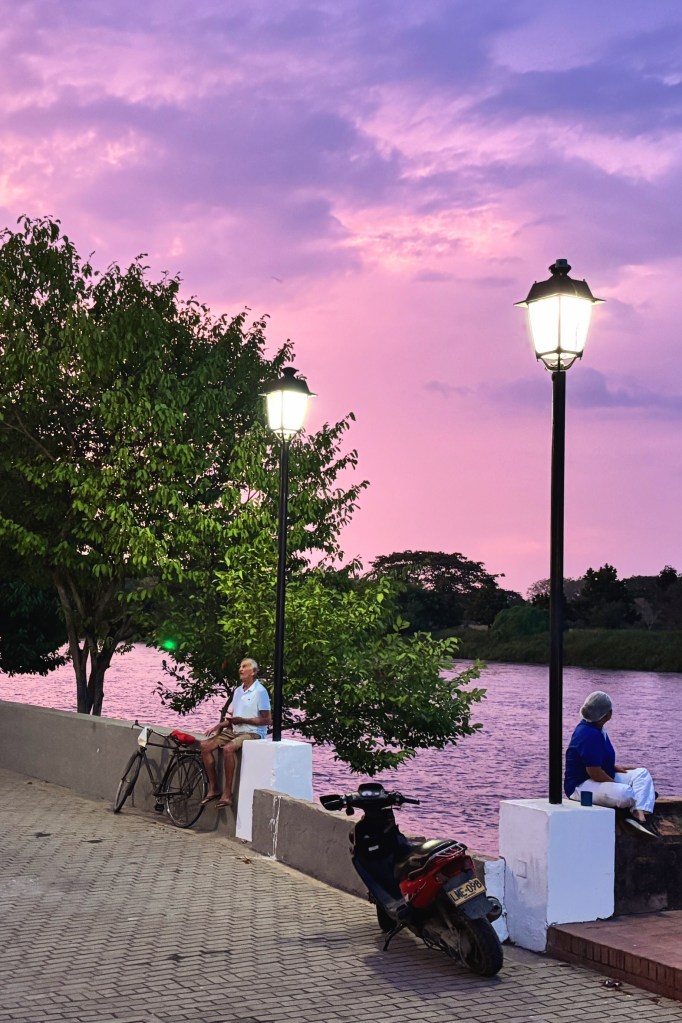
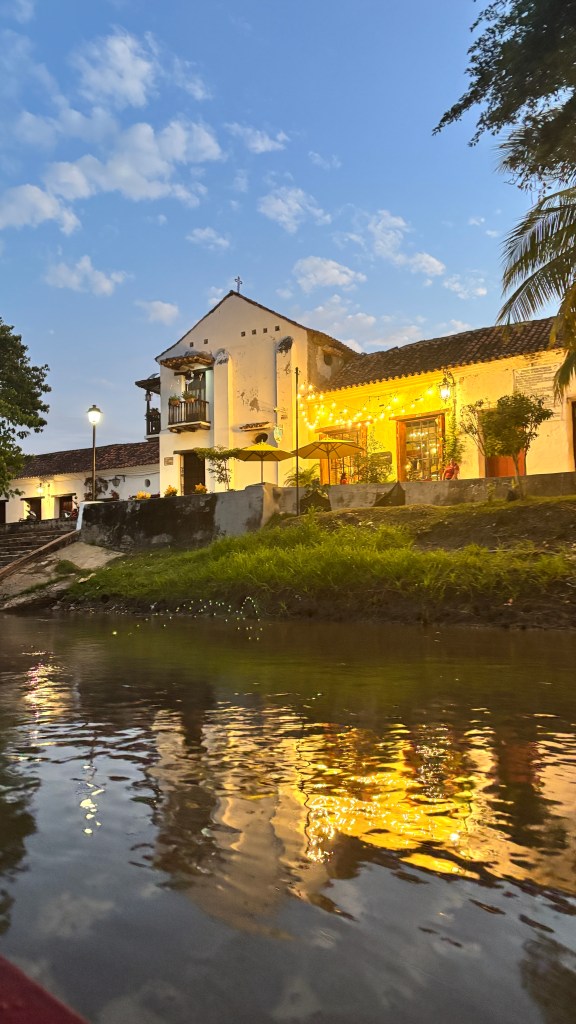
Start at the waterfront walkway that runs the full length of town. Early morning is when it belongs to locals: runners, cyclists, football in the stadium at the southern end starting around 5am before the heat makes any kind of effort inadvisable. Come back at sunset. Locals gather along the water, some with a cold drink, some with a fishing line dropped into the Magdalena with no particular urgency. The churches catch the last light and everything goes still. Just birdsong and the occasional scooter somewhere behind you. It lasts only a few minutes before the evening noise takes over. Worth waiting for.
Turn away from the river and the churches are right there.

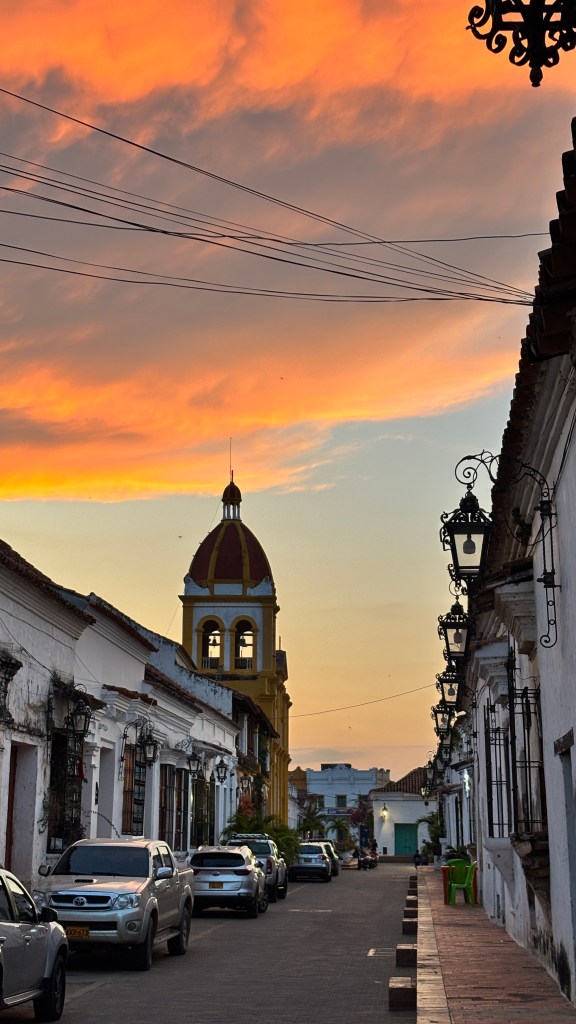


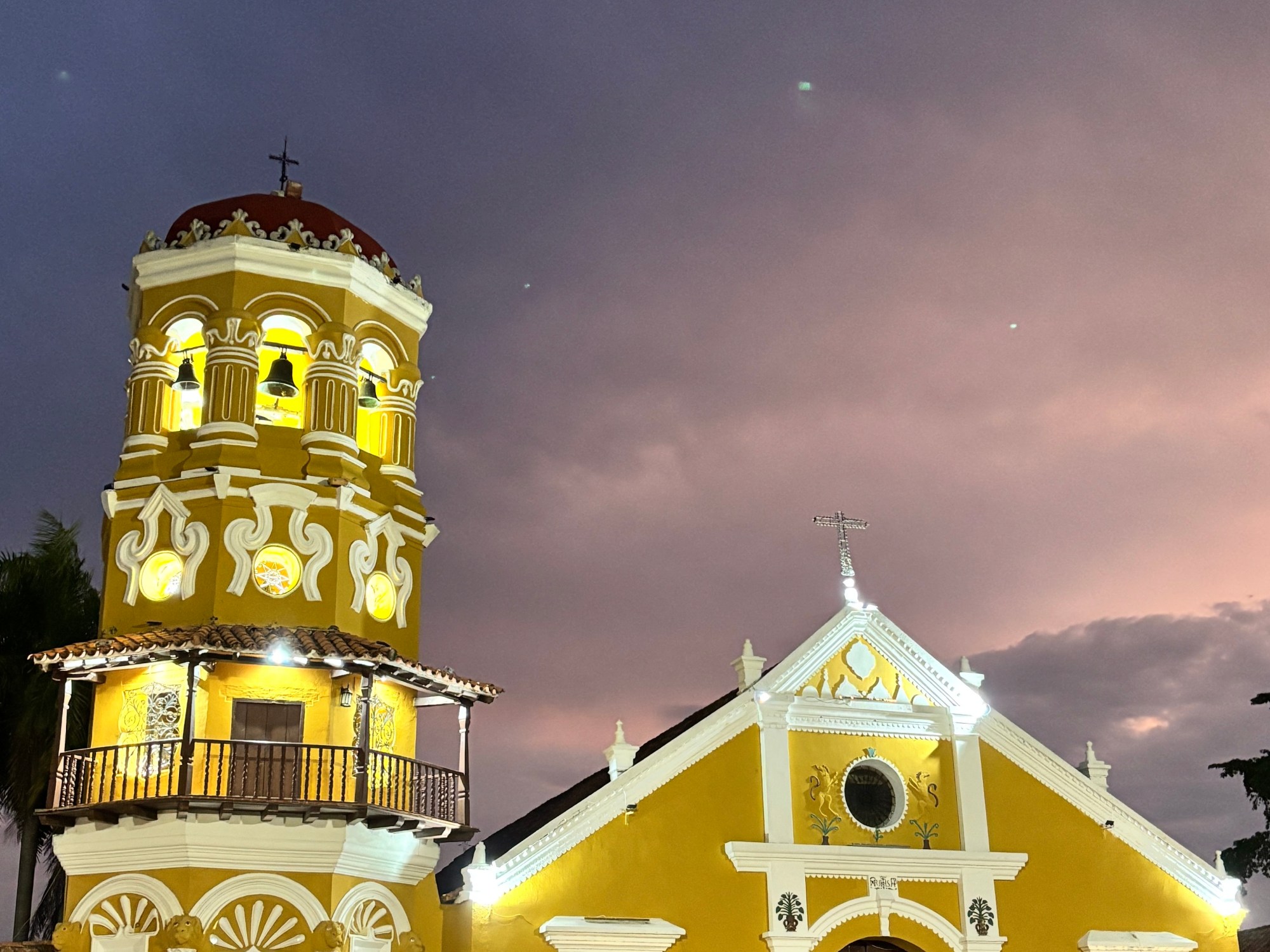
The churches are the architecture. There are six of them, all within walking distance, each with its own devoted congregation who treat them less like tourist attractions and more like living rooms. The Iglesia de Santa Bárbara is the one everyone photographs. Its distinctive octagonal Hispano-Moorish tower has been watching boats arrive on the Magdalena for centuries. Step inside if you can. We found one of the pasos stored in the nave, the elaborate floats carried through the streets during the annual Holy Week procession. Think a sleeping ship in a stone room, surrounded by fresh flowers. The churches keep their own hours, so check the schedule at your hotel before heading out. Showing up to a locked door in the midday heat is its own kind of spiritual experience, but not the one you were after.
Take a chiva (the small three-wheeled vehicle similar to a tuk-tuk) to cover more ground. Cheap, breezy, driven by someone who almost certainly knows everyone in town.
For coffee, go to Café 1700. The interior is the kind of atmospheric that can’t be designed: old photographs of the town’s colonial buildings stitched together into large-format art pieces covering the walls, each one available to buy. You’ll order a second coffee just to keep looking at them. For food, Restaurante Inmaculada is the local recommendation that keeps coming up for good reason. We had fish, fresh and simply cooked, with service that made no fuss about anything. Regional cooking at its most unpretentious.
Beyond the Town
The town is easy to stay inside. The river and the jungle just outside it are worth the effort of leaving.
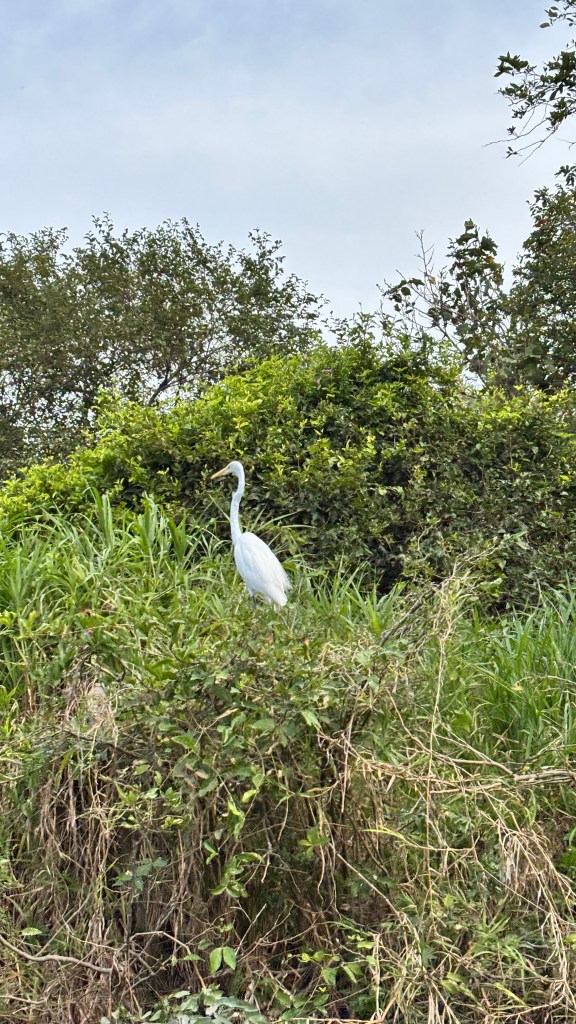
The first is the sunset boat ride on the Magdalena. You leave in the late afternoon and spend a couple of hours moving through waterways and flooded plains. The birdlife is not subtle: herons, egrets, roseate spoonbills, jacanas appearing on the banks with the casual abundance of a place that hasn’t been told it should be impressive. Iguanas drape themselves over branches with the energy of something that has never had a problem. If you’re lucky, a cayman will be visible in the shallows, motionless, doing what caymans do, mostly nothing and occasionally everything. Our guide was calm and unhurried for most of the trip, then suddenly couldn’t contain himself when a rare falcon appeared on a branch ahead of us. He couldn’t believe it was there.


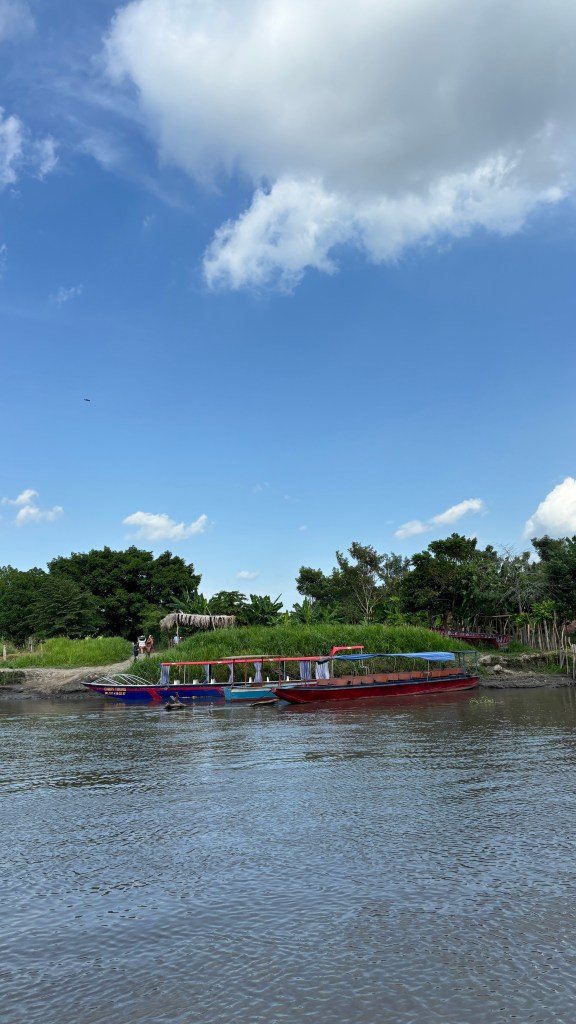
The second is Reserva Natural El Garcero, about an hour’s drive from town. A private 600-acre reserve working to restore the natural floodplain ecosystem that ranching and agriculture have largely replaced across this region. The howler monkeys found us before we found them, announcing themselves from the canopy the moment we arrived, a sound somewhere between a roar and the end of the world. The ground-nesting hummingbirds are harder to spot but worth the patience. Crouching over a tiny nest in the grass, watching something that small hold its ground, you understand what this reserve is trying to protect.
El Garcero requires planning. Book ahead, confirm transport, and wear clothes you don’t mind getting dirty. It’s not a manicured nature walk. That’s the point.
Note: combine the sunset boat ride with an early evening back on the waterfront. García Márquez reportedly drew on the spirit of Mompox for Macondo in One Hundred Years of Solitude. Standing on the riverbank at dusk, that’s not hard to believe. Bring mosquito repellent. The river at sunset is beautiful and the mosquitoes know it.
Things to Do
We made heart necklaces at Filigrane de Mompox. Mompox has been producing filigree jewellery for centuries, a technique that arrived with Spanish colonisers carrying North African goldsmithing traditions, then fused with local craft into something entirely its own. The process starts with melting silver and stretching it into thread so thin you can barely hold it without bending it wrong, then shaping that thread by hand into the pattern. It takes patience and a tolerance for imperfection. By the end, everyone in the room had made something they were unexpectedly proud of, and left knowing in their hands why people have been making this here for four hundred years.
Your finished piece will not look like the ones in the shop windows. That’s fine. The point is the making, not the product.


The Mompox International Jazz Festival happens every October, when the town’s population multiplies overnight and the streets become the venue. Musicians play in plazas, along the waterfront, in the dedicated performance space. It’s the most visited time of year, worth knowing whether you want the festival or want to avoid it.
Note: for the Jazz Festival, book accommodation well in advance. Outside October, late December through March is the dry season and the most comfortable time to visit.
Where to Stay
We stayed at Hotel La Gloria, steps from the historic centre, with private balconies overlooking the street, a pool, and a restaurant cooking local food. Easy to leave in the morning and easier to come back to in the afternoon.
Hotel San Rafael is the best option in town, a 17th-century colonial mansion facing the Magdalena with high ceilings, wide corridors that channel the river breeze, and two tropical gardens. Note: no hot water, which in Mompox’s climate you will not miss.
Casa Sinning is a restored colonial house, intimate and unhurried. Hotel Bohemia blends colonial bones with contemporary design and has more personality per square metre than anywhere else in town.
The Magdalena River Route
The Magdalena River is the spine of Colombia. It stretches over 1,500 kilometres from the Andes to the Caribbean, shaped the country’s economy, carried its trade, and inspired Gabriel García Márquez to call it the River of Life. For most of the 20th century, after the river shifted course in 1969 and commerce moved elsewhere, the communities along its banks were largely left alone. That isolation is precisely what makes the river worth travelling now.
AmaWaterways launched the first luxury river cruise on the Magdalena in 2025, with two small ships: the 60-passenger AmaMagdalena and the 54-passenger AmaMelodia. Both are intimate by design, purpose-built for the river, with locally inspired cuisine, cultural programming, and interiors crafted in collaboration with Colombian artisans. The eight-day itinerary runs between Cartagena and Barranquilla, or in reverse, and every stop is a different chapter.
The route passes through San Basilio de Palenque, the first free African community in the Americas, founded in the 1600s by enslaved people who escaped Spanish captors in Cartagena. It stops at El Banco, the birthplace of cumbia, where the music that spread across Latin America was first played on these riverbanks. Then Mompox, which you’ll have already visited overland if you’re reading this. Seeing it from the water, as everyone saw it for three centuries, is a different experience entirely.
What the cruise offers that nothing else can: the river between the towns. Children running to the banks to wave as the ship passes. Scarlet ibises lifting off over flooded plains. Small canoes carrying fishermen who, for now, appear to find the whole thing mildly amusing.
This is not a cheap option. It is, for the right traveller, the correct one.
Two weeks in Colombia, three very different places, each one holding onto itself in a different way.
Cartagena built its walls on purpose: stone and mortar, pirates and empire, a deliberate act of protection that worked so well the walls became the attraction. The Rosario Islands had no walls at all, just water and sky and the relief of a place with nothing to prove. And Mompox got walled off by accident. A river that shifted, a trade route that moved, two centuries of the world simply looking elsewhere.
All three are extraordinary. But Mompox lingers longest. Maybe because its preservation wasn’t planned or the result of any particular intention. The churches, the craft, the cobblestones, the pace. None of it survived because someone decided it should. It survived because the world forgot to come and take it apart.
What gets walled off long enough becomes precious. Mompox just took the scenic route getting there.
Meta description: A guide to Santa Cruz de Mompox, Colombia’s UNESCO World Heritage town on the Magdalena River, and why the journey to get there is half the point.
This is the last of three posts from the same trip to Colombia. It started in Cartagena, inside walls built to keep pirates out, passed through the Rosario Islands, which have no walls to speak of, and ended here in Mompox, a town the Magdalena walled off when it changed course and left alone for the better part of two centuries. Read the other two for the full arc. Or don’t. Mompox does fine as the only thing on an itinerary.

